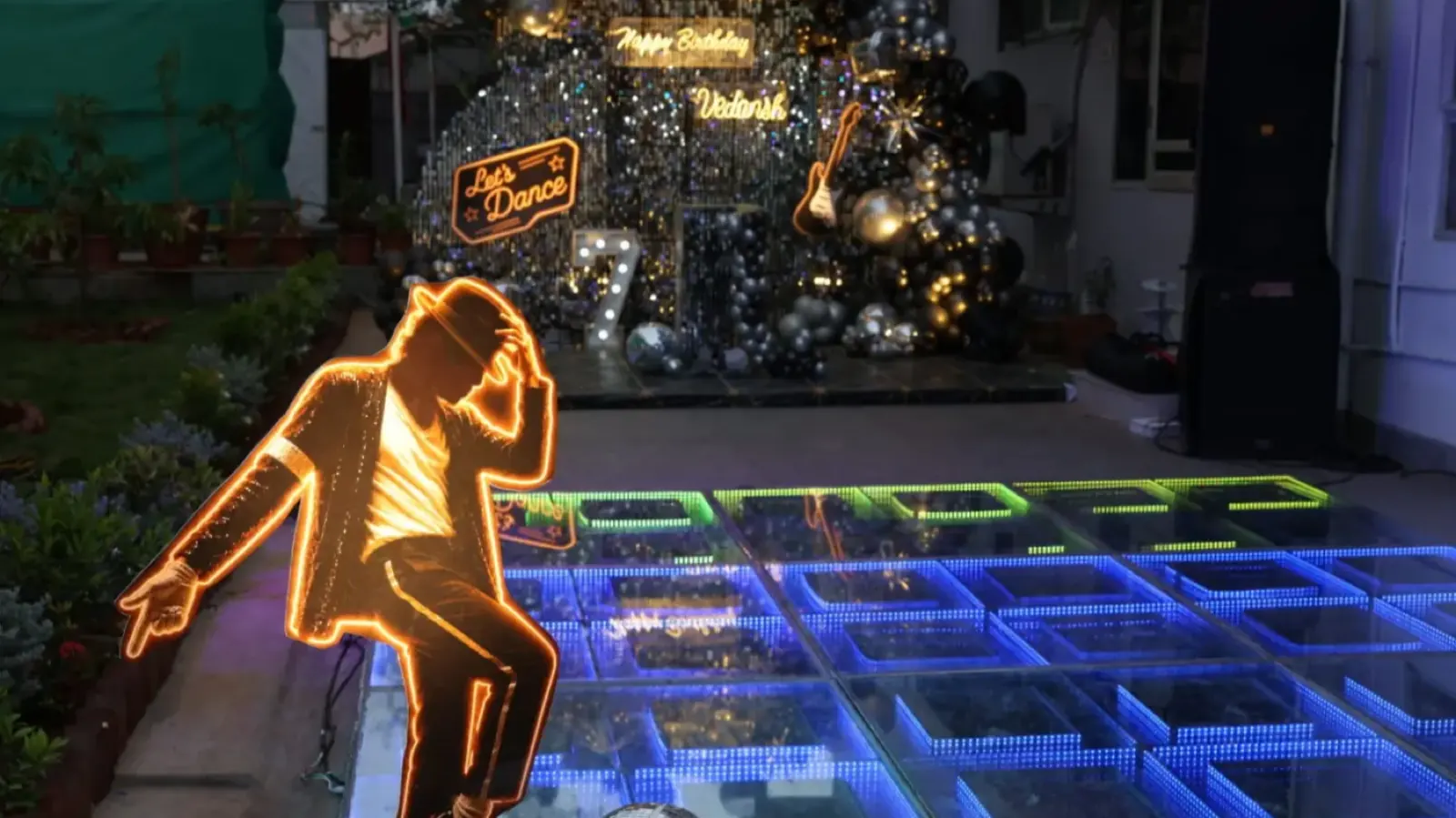
Guests see a stage, some lighting and a schedule that seems to run itself. What they do not see is that an event is a few hundred small decisions, and that almost all of them were made weeks earlier by someone who is not on stage.
This is the process we actually follow, in order, with what we need from you at each stage. If you are planning an event yourself, it works as a checklist.
Stage 1. The first conversation
Before anything is designed, we want to know what the event is for. A wedding reception, a product launch and a school annual day can share a venue and share nothing else.
The questions we ask early:
- What is the occasion, and what should guests feel when they leave?
- How many people, and who are they?
- Date, time of day, and how firm is the date
- Venue, or do you need help finding one
- A budget range, even a rough one
- Which services you need, and which you have already booked
- Anything that has to happen, and anything that must not
You do not need answers to all of these. Two or three are enough to start.
The most useful thing a client can say early is what they do not want. It removes more wrong turns than a mood board adds.
Stage 2. The site recce
We visit the venue before we design anything, for every event, whatever the budget. This is the stage most often skipped, and it is the one that decides whether the plan survives contact with the room.
What we are looking at while we walk it:
- Real dimensions, ceiling height and rigging points
- Where guests enter, and where the queue will form
- Available power, and how far it is from the stage
- Loading access, and how long the set-up will genuinely take
- Sightlines from the worst seat, not the best one
- Where catering works, and how far that is from the guests
- Parking, generator, permissions and safety
A venue that looks perfect in photographs can have a single narrow entrance that adds four hours to the set-up. Better to know in week one than on the morning.
Stage 3. The concept
Now the idea becomes a design, built from the venue we have just walked rather than a folder of previous events.
The inputs are the venue, the type of event, the theme, what guests will be wearing, the colour palette, the budget and your own preferences. Colours, materials, stage, furniture, lighting and layout are chosen against those, in that order.
You should be able to ask why any element is there and get an answer about your event, not about what is trending.
Stage 4. Designing to the budget, not around it
Creativity and budget are the same conversation, not two.
The useful discipline is deciding what has to be excellent and letting the rest be adequate. A product launch that lives on the reveal should spend on stage, screens and lighting. A family gathering where people will sit and talk for four hours should spend on food, seating and sound.
This is why we work mostly with customised solutions rather than fixed packages. The same budget spent in a different order produces a noticeably different event.
Stage 5. The proposal
You get a written proposal covering what is included and how the money is split, across whichever of these apply: event management, décor and stage, sound and lighting, LED and AV, entertainment, photography and videography, catering, branding, guest management, logistics and manpower.
Read the exclusions as carefully as the inclusions. Setup and dismantling labour, transport, backup equipment and what happens if the guest count moves are the four lines that most often turn a cheap quote into an expensive one.
Stage 6. Locking it down
Once the proposal is approved, planning gets specific. Designs are finalised, vendors are confirmed, materials are ordered, the run of show is written, and every team is told what they own and when they arrive.
This is also when we fix the timeline backwards from the event: dismantle, event, set-up, rehearsal, delivery, production, approval. Working backwards from the deadline shows you the real last date for each decision, which is usually earlier than anyone expects.
Stage 7. The week before
The week before is a review week, not a building week. We go back through vendor confirmations, materials, timings, technical requirements, artist schedules, venue permissions, transport, catering counts, manpower and set-up slots.
The purpose is to find the problems while there is still time to solve them quietly.
Stage 8. Event day
We assign a dedicated manager and coordinators, scaled to the event. They run vendor coordination, set-up, the schedule, guest movement, stage and production, entertainment, technical, and every change that arrives during the day.
The measure of this stage is simple: how many times does the host get called? On a well-run event, close to zero. You should be at your own event, not managing it.
Stage 9. When something goes wrong
Something usually does. A vendor is late, a laptop refuses to output, weather turns, a guest count jumps on the morning.
What matters is whether it reaches the guests. That needs three things decided in advance: who has authority to make the call, what backup is already in the room rather than a promise it can be arranged, and who speaks to the client and who does not.
Our approach is to take ownership, fix it quietly and keep the event moving. You should hear about most problems afterwards, not during.
Stage 10. After the last guest leaves
The event is not finished when the programme is. Material comes down, equipment is collected, the venue is handed back in the condition the contract requires, and vendors are closed off.
If nobody has planned this stage, the person doing it at one in the morning is usually the host's family. It belongs in the plan and in the quote.
How far ahead should you start?
Rough guide, based on what actually gets booked out first:
- Large wedding or multi-day event: 4 to 6 months, mainly because venues and good dates go early
- Corporate conference, annual day or dealer meet: 6 to 10 weeks
- Product launch or inauguration: 4 to 8 weeks, more if there is fabrication involved
- Birthday or home celebration: 2 to 4 weeks
Shorter is often possible, and we have delivered on much less. It usually costs more, because speed is bought with labour and premium hires rather than planning.
The whole process, in one line
Listen, visit the venue, design for it, build the budget deliberately, write it all down, confirm it twice, run it on the day, fix what breaks quietly, and clear up properly afterwards.
Raw Group is a new firm, and the team behind it brings 8+ years in the industry and a record of 1,000+ events delivered before Raw Group was founded. This process is what that experience turned into.
Start at stage one
Tell us the occasion, the date and roughly how many people. We will come back with a plan and a quote, usually the same day.